
PYROSALES TECHNICAL ARTICLE | INDUSTRIAL TEMPERATURE MEASUREMENT
Thermocouples are among the most widely used temperature measurement devices in modern industry. From steel manufacturing and mineral processing to food production, chemical processing, power generation and industrial furnaces, they provide dependable monitoring over an exceptionally broad temperature range.
But how accurate are thermocouples, and how can their accuracy be maintained? The answer depends on the thermocouple type, operating temperature, sensor construction, installation, environment, calibration history and connected instrumentation. High temperatures, oxidation, contamination and mechanical stress can cause drift even when a sensor still gives plausible readings.
Accuracy describes how closely a measured temperature agrees with the actual process temperature. Precision describes consistency of repeated readings, repeatability describes agreement under unchanged conditions, and stability describes performance over time. A thermocouple that repeatedly indicates 805°C when the true temperature is 800°C is repeatable but has a +5°C error.
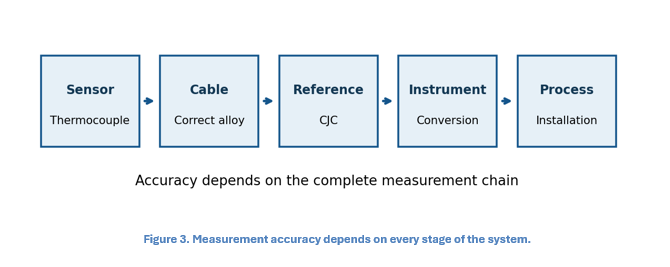
Temperature errors can affect heat-treatment quality, energy consumption, product consistency and safety. Accuracy must therefore be evaluated for the entire measurement system, not only the sensing wire.
Explore Pyrosales technical guidance: How thermocouples work | Thermocouple products
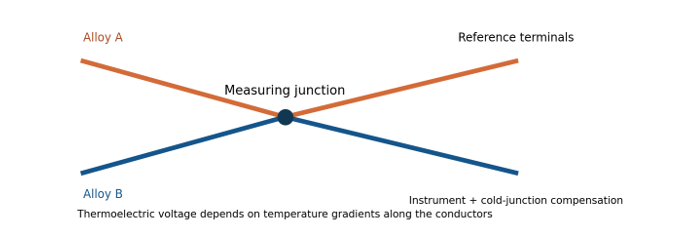
Thermocouples use the Seebeck effect. Two dissimilar conductors form a circuit, with a measuring junction exposed to the process and reference connections at the instrument. The resulting millivolt signal depends on the temperature difference between the measuring and reference junctions. Modern instruments measure the reference terminal temperature and apply cold-junction compensation.
Thermoelectric voltage is influenced by the conductors along temperature gradients, rather than originating solely at the welded tip. Wire homogeneity is therefore important: local metallurgical or chemical changes can change the generated voltage and create errors.
Figure 1. Simplified thermocouple measuring circuit (original schematic).
Compare sensor options: Thermocouple product range | Thermocouple selection guide
Initial thermocouple tolerances are specified by standards including IEC 60584-2 and ASTM E230/E230M. The following illustrative IEC tolerance values apply only within the specified temperature ranges for each type and class. They are not guaranteed total installed-system accuracy.
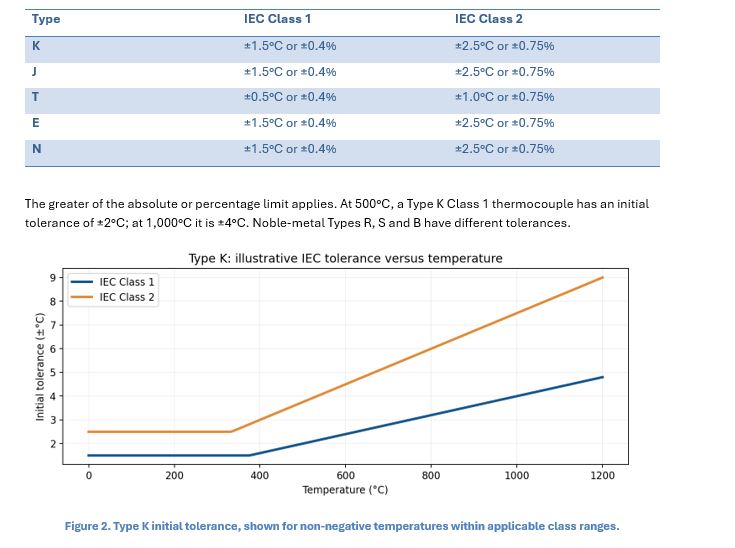
The greater of the absolute or percentage limit applies. At 500°C, a Type K Class 1 thermocouple has an initial tolerance of ±2°C; at 1,000°C it is ±4°C. Noble-metal Types R, S and B have different tolerances.
Figure 2. Type K initial tolerance, shown for non-negative temperatures within applicable class ranges.
Browse suitable Pyrosales products: General-purpose thermocouples | All thermocouples
Common in furnaces, kilns and manufacturing equipment. Offers broad temperature capability, but prolonged exposure to certain high-temperature conditions can cause drift.
Developed for improved thermoelectric stability and oxidation resistance in some demanding environments compared with Type K.
Well suited to refrigeration, laboratory and low-temperature measurement, with tight initial tolerance at appropriate temperatures.
Platinum-based thermocouples used in specialised high-temperature processes, glass, ceramics and furnaces; they require suitable protection from contamination.
Prolonged high-temperature exposure can cause oxidation, diffusion, structural changes and other metallurgical effects. Different portions of the wire experience different temperatures, potentially producing inhomogeneity and altered EMF output.
Related technical guidance: Thermocouple protection sheaths
Reactive gases, sulphur, carbon-rich environments, molten materials and metallic contaminants may alter the thermoelements. Appropriate stainless steel, nickel-alloy or ceramic protection must be selected for the specific process.
Vibration, bending, fatigue and damage to connections can reduce reliability. Mineral-insulated metal-sheathed constructions provide robust options, but mounting, support and bend radius still matter.
Small-diameter elements can respond quickly because of low thermal mass, while larger elements often offer greater robustness. Diameter affects response and durability, but does not alone define accuracy class.
Insufficient immersion allows heat conduction along the sheath to bias readings. Position sensors where temperature represents the intended process, avoiding unrepresentative walls, dead zones or thermal gradients.
Related installation resource: Thermocouple cable colour chart
Millivolt signals are vulnerable to electrical interference. Use appropriate extension or compensating cable, routing, shielding, grounding and instrumentation. A local transmitter can provide a more robust 4–20 mA output.
A thermocouple measures a temperature difference. The measuring instrument must account for the reference terminal temperature. Errors in cold-junction compensation, unstable cabinet temperatures and poor terminal connections can create offsets even when the thermocouple is sound.
Related calibration information: Why calibrate a thermocouple? | Pyrosales calibration services
Calibration compares thermocouple readings with a suitable reference standard at controlled test temperatures and documents deviations, corrections and uncertainty. Calibration does not repair altered sensor materials. Where unacceptable errors are found, the remedy may be instrument adjustment, a validated correction or sensor replacement.
Laboratory calibration provides controlled conditions and traceability. Field verification can reveal system faults under operating conditions. However, an inhomogeneous used thermocouple may behave differently if removed and tested under a new temperature gradient, so in-situ checks may be valuable for critical processes.
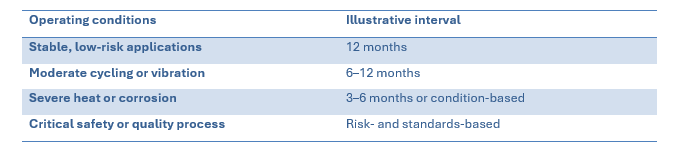
A 12-month interval is a common starting point, but no single interval suits every process. Calibration history, required accuracy, risk and operating conditions should determine the schedule. The intervals below are illustrative and must not override applicable standards or site procedures.
Pyrosales publishes information about temperature calibration services, including traceable and NATA-accredited options. Confirm the applicable accredited scope, range and uncertainty for any particular service before booking.
Compare temperature sensing technologies: Identifying RTDs and thermocouples | Temperature sensor products
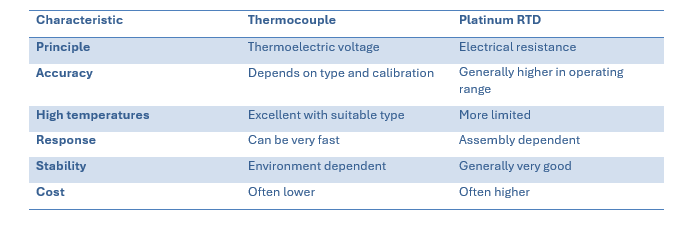
RTDs infer temperature from electrical resistance, commonly using platinum sensing elements. Platinum RTDs generally provide higher accuracy and long-term stability within their specified range. Thermocouples provide wider high-temperature capability, compact construction and often fast response. Selection depends on process conditions rather than accuracy alone.
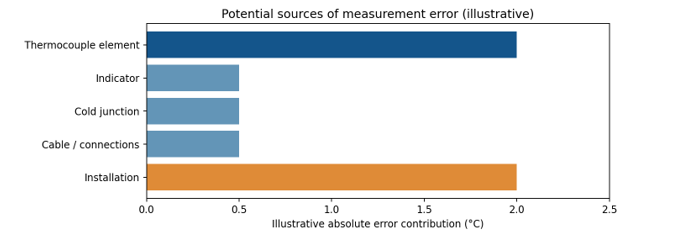
Initial element tolerance is not the complete uncertainty. Indicators, cold-junction compensation, extension cables and installation effects can contribute additional error. In a hypothetical 500°C system, illustrative magnitudes are ±2.0°C for the element, ±0.5°C each for the indicator, cold junction and cable, and ±2.0°C for installation. A worst-case sum is ±5.5°C, but a formal uncertainty budget must account for probability distributions, correlations and systematic effects.
Practical selection guidance: How to choose the right thermocouple | General-purpose thermocouple products
Accurate furnace monitoring supports material properties, heating uniformity, product quality and energy efficiency. Sensor protection and drift monitoring are especially important.
Kilns, dryers, processing vessels and heavy machinery impose vibration, abrasion and thermal stress; robust construction and mounting are essential.
Cooking, cooling and pasteurisation rely on validated temperature control. RTDs may be preferred for accuracy, while thermocouples suit rapid-response or higher-temperature tasks.
Exhaust gas and thermal process monitoring requires sensors capable of tolerating vibration, thermal cycling and demanding atmospheres.
Corrosive media, high pressure and hazardous environments often require compatible protective assemblies and rigorous verification.
Potential signs include gradual offsets, unexpected differences between adjacent sensors, unstable readings, changes in process outcomes, slow response and visible sheath or connection damage. These signs may also reflect wiring or instrument problems, so inspect the full measurement chain before deciding to replace the sensor.
Yes, within a defined range and under suitable conditions, particularly with individual calibration and a capable complete measurement system. It is not a universal guarantee.
They can drift because of heat, oxidation, contamination, thermal cycling and mechanical stress. Rates vary widely.
There is no universally most accurate type. Choose according to temperature, environment, tolerance, stability and required uncertainty.
Yes, they can be checked and characterised, but calibration cannot reverse metallurgical deterioration.
Neither is universally superior. Infrared measurement adds emissivity and optical considerations; thermocouples require contact and appropriate installation.
Thermocouples provide versatile, reliable industrial temperature measurement, but long-term accuracy depends on the complete system. The correct alloy, construction, protection, installation, instrumentation and calibration programme are all essential. Monitoring drift and replacing damaged or contaminated sensors can help preserve process quality, efficiency and safety.
Explore the Pyrosales range: Thermocouple products | Product catalogue | Calibration services
Pyrosales supports industrial thermocouple selection, customised temperature sensors, RTDs and calibration requirements. Visit www.pyrosales.com.au for product and service information.
How accurate are thermocouples?
How to choose the right thermocouple
Why is it necessary to calibrate a thermocouple?
Thermocouple protection sheaths
Thermocouple cable colour chart