
Many products are designed around maximum and minimum operating temperatures, but real damage often happens during the transition between them. A device may survive a hot storage test and a cold storage test separately, then fail when it moves rapidly from one condition to the other. Temperature transition creates expansion mismatch, condensation risk, pressure change, adhesive stress, and fatigue at solder joints and material interfaces. For electronics, batteries, sensors, displays, and industrial components, understanding this transition behavior is essential to reliability.
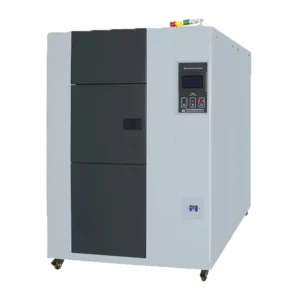
A thermal shock test chamber is designed to expose samples to rapid changes between hot and cold conditions. The goal is to reveal weaknesses that may not appear during slow temperature cycling. In many industries, thermal shock testing is used to qualify components, compare materials, validate suppliers, and investigate field failures. When combined with temperature measurement and post-test inspection, it gives engineers a clear view of how a product responds to severe transition stress.
Temperature changes cause materials to expand and contract. If every material in a product expanded at exactly the same rate, transition stress would be easier to manage. In real products, metals, plastics, adhesives, ceramics, glass, coatings, and solder all have different coefficients of thermal expansion. When the temperature changes quickly, those materials do not always move together. Interfaces become stressed, cracks begin, gaps open, and electrical contact can change. Repeated exposure can turn a small weakness into a functional failure.
This is especially important in electronics. A PCB assembly contains copper traces, laminate, solder joints, component bodies, underfill, connectors, and sometimes conformal coating. Each material responds differently to heat and cold. A thermal shock profile can reveal solder fatigue, delamination, cracked components, connector movement, and intermittent electrical behavior. For batteries, fast transitions can affect cell temperature gradients, pack seals, venting components, adhesives, sensor mounting, and BMS wiring.
Temperature cycling and thermal shock are related, but they are not the same. In a temperature cycling test, the sample remains in one workspace while the chamber gradually changes the air temperature. This is useful for life testing, material aging, and repeated exposure to expected environmental changes. In thermal shock testing, the sample is moved between hot and cold zones, or the chamber produces a much faster transition. The stress is more abrupt and often more severe.
Both methods have value. A temperature humidity chamber may be the better choice for long-duration damp heat, controlled cycling, storage, and operation tests. A thermal shock system is the better choice when the test requirement is rapid transfer or steep transition. Many reliability programs use both because they reveal different failure modes.
During temperature transition testing, the chamber set point is only one part of the story. Engineers should also monitor sample temperature, internal temperature gradients, functional output, electrical resistance, current leakage, battery voltage, mechanical deformation, and visual changes. A small sample may follow the chamber temperature quickly, while a large sample may lag behind. A battery module or dense assembly may develop internal gradients that are more important than the air temperature itself.
Instrumentation should be planned before the test begins. Thermocouples or RTDs may be attached to key locations. Cables should be routed through proper ports so that the chamber door remains sealed. Data logging should capture the transition period, not only the dwell time. When failures occur, the timing of the failure can help identify the mechanism. A failure during rapid cooling may suggest contraction stress or condensation. A failure during high-temperature dwell may suggest material softening, leakage, or thermal aging.
Thermal transition testing is used in many product categories. Automotive electronics may experience rapid temperature changes when vehicles move between climates or when components near the engine heat up and cool down. Outdoor sensors and telecom equipment may see cold nights and hot daytime operation. Industrial controls may be installed in factories with large temperature variations. Batteries may be transported, stored, charged, and discharged under changing conditions. Aerospace and defense electronics often require even more severe thermal stress screening.
For industrial buyers, the test chamber should match the application. A small component chamber is not enough for a large assembly. A chamber with slow recovery may not meet the required transition profile. A system without appropriate safety features may not be suitable for powered batteries or high-energy samples. Working with an experienced environmental test chamber supplier helps teams match the chamber to the product, sample load, test standard, and laboratory layout.
A successful test is not only a pass. Sometimes the most valuable result is a controlled failure that teaches the team where the design is weak. Engineers should inspect samples before and after testing, compare functional data, and review any drift or intermittent behavior. Microscopy, cross-sectioning, electrical testing, leak testing, and mechanical inspection may be used after severe thermal shock. The goal is to connect the observed failure to a design, material, process, or supplier decision that can be improved.
Test results should also guide future test planning. If a product fails early, the next step may be a root cause study rather than repeating the same profile. If the product passes easily, the team may decide to increase cycle count, test larger samples, add humidity exposure, or evaluate powered operation. Reliability testing works best when it is part of an engineering feedback loop.
When comparing chambers, engineers should look beyond the headline temperature range. Recovery time, zone uniformity, transfer method, sample basket size, sensor placement, and controller resolution all influence the usefulness of a thermal shock test. If the chamber cannot recover quickly after the sample transfer, the actual stress may be lower than expected. If the hot and cold zones are not uniform, two samples in the same run may experience different conditions. If the sample is too large for the basket or airflow path, the test may no longer represent the specified profile.
Humidity is another consideration. Traditional thermal shock is often a dry-temperature transition test, but products in the field may also see moisture and condensation. Some programs therefore combine thermal shock with separate damp heat or humidity cycling tests. The sequence can matter. A sample exposed to humidity first may fail differently during thermal shock because moisture has entered coatings, seals, or materials. Planning the test sequence around likely field conditions can make results more meaningful.
Before purchasing a thermal shock system, buyers should review more than the chamber price. They should consider power requirements, floor space, heat rejection, noise, maintenance access, safety interlocks, data communication, spare parts, and local service support. A chamber that fits the specification but not the facility can delay a project. For large or high-risk samples, the team may also need special fixtures, cable ports, reinforced shelves, fire safety planning, or remote monitoring.
A good supplier discussion starts with the sample and the test purpose. The buyer should describe the sample mass, dimensions, material, heat load, required high and low temperatures, transfer time, dwell time, cycle count, and applicable standards. With that information, the supplier can recommend a chamber configuration that is realistic, rather than simply quoting a standard model that may not match the workload.
Thermal transition tests should include clear acceptance criteria before the first run begins. For some products, the criteria may be no visible cracking, no leakage, and normal function after the final cycle. For electronics, the criteria may include continuous communication, stable resistance, no reset, no abnormal current draw, and no loss of calibration. For batteries, the criteria may include voltage stability, no swelling, no leakage, no abnormal temperature rise, and no safety event. The criteria should match the risk of the product.
It is also useful to define intermediate inspection points. A sample that fails after 10 cycles provides different information from one that fails after 200 cycles. If the test only checks the sample at the end, the team may lose important timing data. Planned inspections and data logging help engineers understand the progression of damage.
Temperature transition testing is one of the most effective ways to reveal hidden reliability risks. Rapid movement between hot and cold conditions exposes material mismatch, assembly weakness, electronic instability, and battery packaging issues that may not appear in steady-state testing. By choosing the right chamber, monitoring the sample carefully, and interpreting results thoughtfully, engineers can make products more reliable before they face real-world environmental stress.