
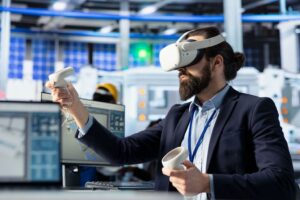
Great products rarely happen by chance. Behind every successful product is a process of testing ideas, solving problems, and finding better ways to meet customer needs. Today, technology plays a major role in making that process faster and more effective.
Tools such as data analytics, artificial intelligence, automation, and digital design help businesses understand market demands, improve product quality, and bring new ideas to life with greater confidence. Instead of relying on guesswork, companies can make informed decisions based on real insights. This shift is changing how products are developed, helping businesses innovate, adapt quickly, and stay competitive in a fast-moving market.
Here’s something worth knowing about Seattle: it’s quietly become one of North America’s most dynamic tech manufacturing corridors. Aerospace firms, medical device companies, and hardware startups all operate here in unusual concentration, pushing the limits of what physical products can do. That critical mass has pulled specialized service providers into the region, making it a natural home for advanced manufacturing. When companies need to accelerate physical concept development, rapid prototyping in Seattle is frequently the answer, delivering everything from FDM and SLS printing to direct metal fabrication with genuinely fast turnaround.
None of this is happening in a vacuum. Tech-driven business innovation has graduated from competitive advantage to competitive survival. The margin between companies that move fast and companies that move slow is growing quickly.
AI helps teams identify patterns in customer feedback before a product ever ships. That’s powerful. IoT embeds real intelligence into everyday objects, creating connected experiences that improve over time. Automation absorbs repetitive workloads, freeing engineers to tackle problems that actually require human judgment. Together, these technologies don’t just improve speed, they change what’s possible.
Technology alone doesn’t generate innovation. Companies that consistently outperform competitors combine the right tools with specific goals and teams that understand how to use both. Without strategic alignment, even a sophisticated tech stack becomes expensive, underutilized infrastructure. The tools are only as good as the intent behind them.
Understanding what’s driving this transformation matters. But the real edge comes from knowing precisely how to apply it.
AI doesn’t just accelerate processes, it enables better product decisions earlier in the cycle. Teams use machine learning models to validate market demand before full investment, run simulated user scenarios, and surface design vulnerabilities before they compound into expensive corrections.
A report from sdcexec.com reveals that roughly 53% of companies say they’re developing products faster than ever, yet more than 80% are still actively seeking ways to accelerate further, with 65% citing competitive pressure as the primary driver. In that environment, AI-powered iteration isn’t a luxury. It’s a requirement.
Smart home devices, remote patient monitors, industrial sensors, they all share a defining characteristic: embedded connectivity that transforms a static product into a living data source. That data flows back into product innovation strategies, enabling teams to refine products continuously post-launch rather than waiting on the next version cycle to correct what went wrong.
Digital twins allow engineers to subject a product to thousands of virtual conditions before a single physical component is manufactured. They reduce costly physical testing, surface design problems early, and model real-world stress behavior with striking accuracy. It remains one of the most underutilized capabilities in product development, which makes it one of the highest-leverage opportunities available.
Cross-functional teams operating in agile sprints respond to feedback in real time, not at the next quarterly review. Platforms like Jira, Figma, and Miro give distributed teams shared visibility across the product lifecycle. Fewer silos, faster decisions, and products that actually reflect what customers need. That formula works consistently.
With a solid strategic foundation established, it’s worth examining what’s actively emerging now.
Supply chain fraud is a genuine, growing problem, not a theoretical one. Blockchain establishes an immutable record of every product touchpoint, from raw materials through final delivery. Electronics manufacturers and food brands are already deploying it to verify authenticity and build the kind of customer trust that’s difficult to manufacture any other way.
Green technology is no longer optional. Customers expect it. Regulators are moving toward requiring it. Investors are scrutinizing it. Digital product passports, which track a product’s complete lifecycle from manufacture through disposal, are increasingly central to responsible technology in product development. Companies that build sustainability from the start discover it simplifies development rather than adding friction.
Big data has made it possible to offer genuinely customized products without sacrificing operational efficiency. Brands like Nike and Dell demonstrated years ago that on-demand personalization scales, and customers demonstrate consistently that they’ll pay a premium for it. That dynamic isn’t weakening.
What are technology-driven approaches?
“Technology Driven” refers to a management philosophy focused on developing new products or services based on a firm’s technical capabilities rather than proven demand, often leading to breakthrough innovations in Computer Science and related fields.
What are the 5 C’s of innovation?
HFMA found innovation can grow from combinations of five “Cs”: competition, collaboration, culture, catalysts, and constraints, each playing a unique role in driving meaningful, sustainable product advancement.
How does sustainability connect with product innovation strategies?
Sustainable technology reduces waste, meets regulatory expectations, and builds long-term brand loyalty. When baked into product innovation strategies from the start, green design choices actually simplify development rather than complicating it.
Tech-driven business innovation isn’t a finish line, it’s an ongoing discipline. The companies outperforming their competitors right now aren’t necessarily the ones with the largest budgets. They’re the ones deploying AI, IoT, simulation tools, and agile methodologies with genuine strategic clarity. Whether you’re a startup validating a first prototype or an established organization rethinking an entire product line, the path forward starts with deliberate strategy and partners capable of executing on it. The perfect moment to begin doesn’t exist. The right moment is now.